
집합론
Equivalence Relations
The definition and properties of equivalence relations
Now we examine equivalence relations.
Definition of Equivalence Relations
Definition 1 A binary relation \((R,A,A)\) is called symmetric if \(x\mathrel{R}y\) implies that \(y\mathrel{R}x\) also holds. If
\[(x\mathrel{R}y)\wedge(y\mathrel{R}z)\implies x\mathrel{R}z\]holds, we call it transitive. Finally, if for all \(x\) we have \(x\mathrel{R}x\), then \(R\) is said to be reflexive on \(A\). A relation \(R\) that is reflexive, symmetric, and transitive is called an equivalence relation.
From now on, when \(R\) is an equivalence relation, we will use \(x\sim_{\tiny R}y\). When there is no risk of confusion, we also write \(x\sim y\) or \(x\equiv y\).
Example 2 On a given set \(A\), the relation \(x=y\) is an equivalence relation on \(A\), and in this case \(R\) equals the set \(\Delta_A\). On the other hand, one can easily check that the relation ‘\(x\in A\) and \(y\in A\)’ is also an equivalence relation on \(A\). The set representing this relation is exactly \(A\times A\).
On a given set \(A\), consider an arbitrary equivalence relation \(R\). Since \(R\) is reflexive, \(\Delta_A\subseteq R\), and the inclusion \(R\subseteq A\times A\) is obvious. Therefore, of the two examples given above, the first is the smallest equivalence relation that can be defined on \(A\), and the second is the largest.
Summarizing this in formulas, we have the following.
Proposition 3 A binary relation \((R,A,A)\) is an equivalence relation if and only if the following three conditions hold:
\[\pr_1R=A,\qquad R=R^{-1},\qquad R\circ R=R\]Proof
First, assume that \(R\) is an equivalence relation.
- For all \(x\in A\), we have \((x,x)\in R\), and so \(\pr_1R=A\) holds.
-
Also, since \(R\) is symmetric, \(x\sim_{\tiny R} y\iff y\sim_{\tiny R}x\) holds, and therefore
\[(x,y)\in R\iff (y,x)\in R\iff (x,y)\in R^{-1}\tag{1}\]from which \(R=R^{-1}\) follows.
- Finally, we must show that \(R\circ R=R\). First, let \((x,y)\in R\) be given. Since \(R\) is reflexive, \((x,x)\in R\), and thus from \((x,x)\in R\) and \((x,y)\in R\) we know that \((x,y)\in R\circ R\) holds. Conversely, let \((x,y)\in R\circ R\) be given. Then there exists some \(z\in A\) such that \((x,z)\in R\) and \((z,y)\in R\). Now by the transitivity of \(R\), we have \((x,y)\in R\).
Now suppose that \(R\) is a binary relation satisfying the three given conditions.
- From \(R=R^{-1}\), reversing the logic of equation (1) shows that \(R\) is symmetric.
- Assume that \(x\mathrel{R}y\) and \(y\mathrel{R}z\) hold. Then \((x,z)\in R\circ R=R\), so we know that \(R\) is transitive.
- Finally, from \(\pr_1R=A\), we know that there exists some \(y\in A\) such that \((x,y)\in R\). Now since \(R\) is symmetric, \(y\mathrel{R}x\) also holds, and by transitivity \((x\mathrel{R}y)\wedge(y\mathrel{R}x)\implies x\mathrel{R}x\) holds. That is, \(R\) is reflexive.
In this post, we examine the key properties of equivalence relations, and in the next post, we will examine equivalence relations that appear in various situations.
Equivalence Relations and Partitions
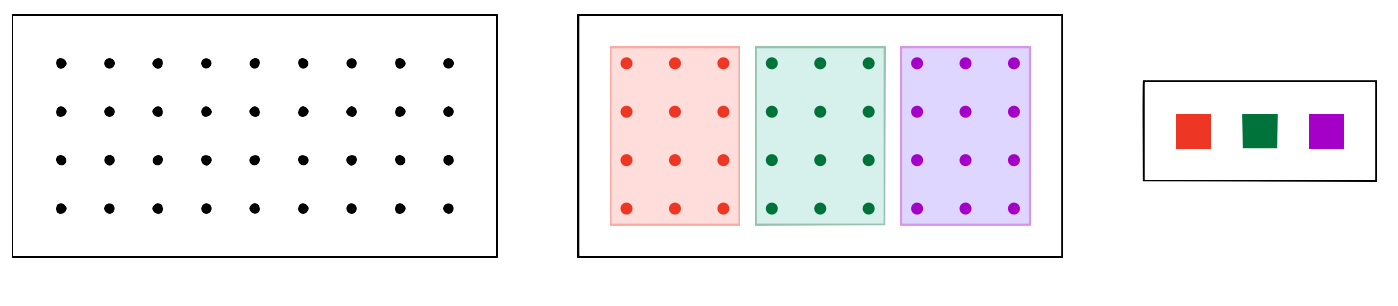
Definition 4 Consider an equivalence relation \((R,A,A)\). For any \(x\in A\), the section at \(x\), \(R(x)\), is called in \(R\) the equivalence class of \(x\). The collection of such equivalence classes is called the quotient set of \(R\), and is denoted by \(A/R\).
By definition, \(R(x)\) is the set of elements regarded under the equivalence relation \(R\) as equivalent to \(x\). In many cases, the equivalence class containing \(x\) is written as \([x]_R\). When there is no risk of confusion, their set \(A/R\) is also denoted by \(A/\mathord{\sim}\).
Example 5 We have already seen that on a set \(A\), \(x=y\) is an equivalence relation. In this relation, the equivalence class of \(x\) is the set \(\{x\}\). Meanwhile, in the same example, the relation ‘\(x\in A\) and \(y\in A\)’ was also an equivalence relation, in which case the equivalence class of \(x\) becomes the whole of \(A\).
In the preceding Example 2 we said that \(\Delta_A\) is the smallest and \(A\times A\) is the largest; however, rather than comparing them by set inclusion, it is more common to say that \(\Delta_A\) is the finest equivalence relation and \(A\times A\) is the coarsest equivalence relation from the above point of view. (§Sum of Sets, ⁋Definition 1)
Lemma 6 For an equivalence relation \((R,A,A)\), define \(p:A\rightarrow A/R\) by \(x\mapsto [x]_R\). Then \(p\) is a function, and \(x\sim_{\tiny R} y\) is equivalent to \(p(x)=p(y)\).
Proof
First, it is not difficult to show that \(p\) defined by the above formula is indeed a function. Here we only show the equivalence.
First, assume that \(x\sim_{\tiny R} y\). Then from \(y\in [x]_R=R(x)\) we have \(\{y\}\subseteq R(x)\), and therefore by §Binary Relations, ⁋Proposition 5, §Operations on Binary Relations, ⁋Proposition 6, and Proposition 3
\[R(y)\subseteq R(R(x))=(R\circ R)(x)=R(x)\]holds. Since \(R\) is an equivalence relation, we may interchange the roles of \(x\) and \(y\), and thus \(R(x)=R(y)\) holds.
Conversely, if \([x]_R=[y]_R\), then from \(x\in [x]_R=[y]_R\) we obtain \(y\sim_{\tiny R} x\), and therefore the lemma holds.
The above function \(p\) is called the canonical projection. Then the subset of \(A\), \([x]_R\subseteq A\), is the preimage of the element \([x]_R\in A/R\) of the quotient set under the function \(p\), so we know that the equivalence classes are disjoint. Also, since \(R\) is reflexive, any \(x\in A\) belongs to \([x]_R\), and therefore the equivalence classes are all nonempty and their union is the whole of \(A\). That is, the equivalence relation \((R,A,A)\) induces a partition of \(A\). (§Sum of Sets, ⁋Definition 4)
The following proposition shows that the converse also holds.
Proposition 7 Let \((A_i)_{i\in I}\) be a partition of \(A\). Then
there exists some \(i\) such that \(x,y\in A_i\)
is an equivalence relation with respect to \(x\) and \(y\).
Proof
Write the above relation as \(R\).
- That \(R\) is reflexive on \(A\) is obvious.
- If \(x\) and \(y\) belong to the same set, then \(y\) and \(x\) also belong to the same set, so if \(x\mathrel{R}y\) then \(y\mathrel{R}x\). That is, \(R\) is symmetric.
- Finally, if \(x\mathrel{R}y\) and \(y\mathrel{R}z\), then \(x,y\in A_i\) and \(y,z\in A_j\). But \(y\in A_i\cap A_j\) and \((A_i)_{i\in I}\) is a partition, so \(i=j\). Therefore \(x,z\in A_i\), and the proposition holds.
References
[Bou] N. Bourbaki, Theory of Sets. Elements of mathematics. Springer Berlin-Heidelberg, 2013.
Share on
Comments
- Public repository: a deleted comment stays in the Git history.
- The password and the email are encrypted and kept in Cloudflare KV alone.
No comments yet.