
집합론
Examples of Equivalence Relations
Examples of equivalence relations, saturation, and isomorphism theorems
In this post, we examine examples of equivalence relations that appear in various contexts.
Equivalence relation defined by a function
In the previous post, we saw that from an equivalence relation \((R,A,A)\), the canonical function \(p:A\rightarrow A/R\) is well defined; the converse also holds. That is, given any function, we can use it to construct an equivalence relation.
Proposition 1 Let a set \(A\) and a function \(f\) with domain \(A\) be given. Then the relation between \(x\) and \(y\) defined by \(x,y\in A\) and \(f(x)=f(y)\) is an equivalence relation on \(A\).
Proof
That the given relation is reflexive on \(A\) is obvious. On the other hand, if \(f(x)=f(y)\) then \(f(y)=f(x)\), and if \(f(x)=f(y)\) and \(f(y)=f(z)\) then \(f(x)=f(z)\), so this relation is also symmetric and transitive.
Definition 2 The equivalence relation defined in the above proposition is called the equivalence relation defined by \(f\).
For an equivalence relation \((R,A,A)\) and the induced \(p:A\rightarrow A/R\), one can verify that the equivalence relation \(R\) is exactly the same as the equivalence relation obtained by applying Definition 2 to \(p\).
Equivalence relations compatible with a unary relation
Definition 3 Let \((R,A,A)\) be an equivalence relation. Then a unary relation \(P\) is compatible with \(R\) if \(P(x)\wedge (x\sim_{\tiny R}y)\implies P(y)\).
For example, the unary relation
\(x\) is even
is compatible with the equivalence relation
\(x-y\) is a multiple of 4.
From the viewpoint of equivalence classes, the above definition can be rewritten as follows.
Proposition 4 Let \(R\) be an equivalence relation on a set \(A\), and let \(P\) be a unary relation compatible with \(R\). Then the statement that \(t\in A/R\) and there exists some \(x\in t\) such that \(P(x)\) and the statement that \(t\in A/R\) and \(P(x)\) holds for all \(x\in t\) are equivalent.
Proof
In other words,
When \(P\) is compatible with \(R\), if a single element of an equivalence class satisfies \(P\), then \(P\) holds for all elements in the same class as that element.
And this is exactly the definition of a compatible unary relation.
The converse direction is obvious. Suppose for some \(t\in A/R\) there exists \(a\in t\) such that \(P(a)\). Then for every \(x\in t\) we have \(a\sim_{\tiny R}x\), so \(P(x)\) holds.
Saturation of an equivalence relation
Definition 5 Let \(R\) be an equivalence relation on \(A\) and let \(X\) be a subset of \(A\). We say that \(X\) is saturated with respect to \(R\) if the unary relation \(x\in A\) is compatible with \(R\).
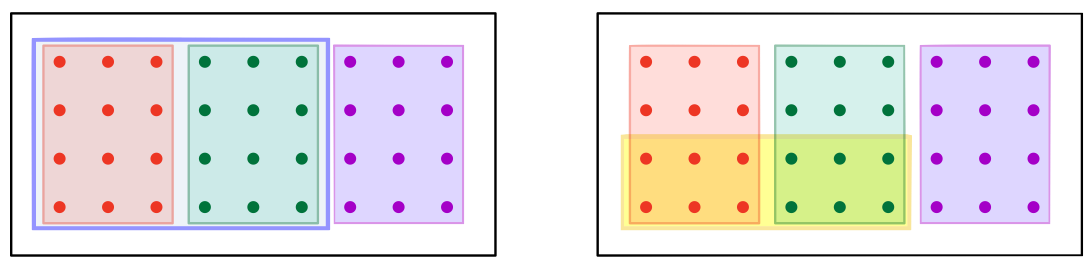
According to the above definition, for a set \(X\) to be \(R\)-saturated, the condition that if \(x\in X\) then \(R(x)\subseteq X\) must necessarily hold. Therefore, an \(R\)-saturated subset \(X\) is a set that can be expressed as \(\bigcup_{x\in B}R(x)\) for some subset \(B\subseteq A\). From this, the following two results can be easily verified.
- If \((A_i)_{i\in I}\) is a family of \(R\)-saturated subsets, then \(\bigcup_{i\in I} A_i\) and \(\bigcap_{i\in I} A_i\) are also \(R\)-saturated.
- If \(X\subseteq A\) is \(R\)-saturated, then \(A\setminus X\) is also \(R\)-saturated.
Now consider the canonical projection \(p:A\rightarrow A/R\) and \(X\subseteq A\). By §Operations on Binary Relations, ⁋Proposition 7, we obtain
\[p^{-1}(p(X))\supseteq X\]In general, the reverse inclusion does not hold, but if \(X\) is \(R\)-saturated, then the reverse inclusion also holds. For each \(x\in X\), since \(p^{-1}(\left\{p(x)\right\})\subseteq X\), we have
\[p^{-1}(p(X))=\bigcup_{x\in X}p^{-1}(\left\{p(x)\right\})\subseteq X\]On the other hand, even if \(X\) is not \(R\)-saturated, the set \(p^{-1}(p(X))\) is \(R\)-saturated. To see this, choose any \(x\in p^{-1}(p(X))\) and suppose any \(x'\) satisfying \(x\sim_{\tiny R} x'\) is given. Then
\[x\sim_{\tiny R} x'\iff p(x)=p(x')\]and since \(p(x)\in p(X)\) by the given assumption, we obtain \(x'\in p^{-1}(p(X))\). On the other hand, if \(X'\) is an \(R\)-saturated subset containing \(X\), then
\[X'=p^{-1}(p(X'))\supseteq p^{-1}(p(X))\]so \(p^{-1}(p(X))\) is the smallest \(R\)-saturated subset containing \(X\). We call this the saturation of \(X\).
Canonical decomposition
Definition 6 For an equivalence relation \((R,A,A)\) and a function \(f\) with domain \(A\), we say that \(f\) is compatible with \(R\) if the unary relation \(y=f(x)\) in \(x\) is compatible with \(R\).
That is, for \(f\) to be compatible with \(R\), \(f\) must become a constant function when restricted to each equivalence class. Now applying §Retraction and Section, ⁋Proposition 4, we obtain the following.
Proposition 7 Consider an equivalence relation \((R,A,A)\) and the canonical \(p:A\rightarrow A/R\). Then \(f:A\rightarrow B\) is compatible with \(R\) if and only if there exists \(h:A/R\rightarrow B\) such that \(f=h\circ p\).
That is, the following diagram commutes.
In this case, \(h\) is uniquely determined by a section \(s\) of \(p\) via \(h=f\circ s\).
In particular, suppose \(R\) is the equivalence relation defined by \(f\). (Definition 2) Then we can consider the following diagram.
Here \(\tilde{f}\) is the function obtained by restricting the codomain \(F\) of \(f\) to \(f(A)\), and \(j\) is the canonical injection. From the commutativity of the above diagram, we obtain the equation
\[f=j\circ\tilde{f}=j\circ h\circ p\]If \(h(t)=h(t')\) for some \(t, t'\in A/R\), then for \(x\in t\), \(x'\in t'\) we have \(f(x)=f(x')\), so \(x\sim_{\tiny R}x'\), and thus \(t=t'\), which shows that \(h\) is injective. However, since the codomain of \(h\) is restricted to the image of \(f\), \(h\) is also surjective. Therefore \(h\) is bijective, and we call the above equation the canonical decomposition of \(f\).
Additionally, suppose an equivalence relation \(S\) is given on the codomain \(B\). Then we first obtain the following diagram.
If \(q\circ f\) is compatible with \(R\), then we say that \(f\) is \((R,S)\)-compatible. By Proposition 7, this is equivalent to the existence of \(h:A/R\rightarrow B/S\) such that \(h\circ p=q\circ f\).
Preimage of an equivalence relation
Let a function \(f:A\rightarrow B\) be given, and consider the equivalence relation \((S,B,B)\) and the canonical \(p:B\rightarrow B/S\).
Then the function \(p\circ f:A\rightarrow B/S\) is naturally defined, and the equivalence relation on \(A\) created by this function via Definition 2 is called the preimage of \(S\) under \(f\).
Quotient of equivalence relations
The following definition was already mentioned in §Equivalence Relations, ⁋Example 5.
Definition 8 For two equivalence relations \(R,S\) defined on a set \(A\), we say that \(S\) is finer than \(R\) if \(x\sim_{\tiny S}y\implies x\sim_{\tiny R}y\) always holds.
Let two equivalence relations \(R,S\) be defined on a set \(A\), and suppose \(S\) is finer than \(R\).
Then the function \(p_S\) is surjective, and \(p_S(x)=p_S(y)\implies p_R(x)=p_R(y)\) always holds. Therefore, there exists a unique \(h:A/S \rightarrow A/R\) such that \(p_R=h\circ p_S\). (§Retraction and Section, ⁋Proposition 4) In this case, we call the equivalence relation that \(h\) defines on \(A/S\) the quotient of \(R\) by \(S\), and denote it by \(R/S\). Passing through the canonical decomposition, we have
and in particular, \(k\) is bijective.
Product of equivalence relations
Finally, suppose two equivalence relations \((R,A,A)\), \((R',A',A')\) are given, and define the relation \((S, A\times A', A\times A')\) by
\(u\sim_{\tiny S}v\) means that there exist \(x\), \(x'\), \(y\), \(y'\) such that \(u=(x,x')\), \(v=(y,y')\) and \(x\sim_{\tiny R}y\), \(x'\sim_{\tiny R'}y'\).
Let \(u=(x,x'),v=(y,y'),w=(z,z')\) be elements of \(A\times A'\). Then
- That \(u\sim_{\tiny S}u\) always holds is obvious, since \(x\sim_{\tiny R}x\) and \(x'\sim_{\tiny R'}x'\).
- If \(u\sim_{\tiny S}v\), then \(x\sim_{\tiny R}y\) and \(x'\sim_{\tiny R'}y'\), so \(y\sim_{\tiny R}x\) and \(y'\sim_{\tiny R'}x'\), and therefore \(v\sim_{\tiny S}u\).
- Suppose \(u\sim_{\tiny S}v\) and \(v\sim_{\tiny S}w\). Then \(x\sim_{\tiny R}y,x'\sim_{\tiny R'}y',y\sim_{\tiny R}z,y'\sim_{\tiny R'}z'\) each hold. Now from \(x\sim_{\tiny R}y\) and \(y\sim_{\tiny R}z\) we get \(x\sim_{\tiny R}z\), and from \(x'\sim_{\tiny R'}y'\) and \(y'\sim_{\tiny R'}z'\) we get \(x'\sim_{\tiny R'}z'\). That is, \(u\sim_{\tiny S}w\) holds.
Therefore \(S\) is an equivalence relation. We call this equivalence relation the product of \(R\) and \(R'\), and denote it by \(R\times R'\).
Let two functions \(f:A\rightarrow B\), \(f':A'\rightarrow B'\) be given, and let \(R\) and \(R'\) be the equivalence relations induced by \(f\) and \(f'\) respectively. Then \(f\times f':A\times A'\rightarrow B\times B'\) is well defined, and through this function we can define an equivalence relation on \(A\times A'\). Let us call this equivalence relation \(S\) for a moment; then for any \(u=(x,x'),v=(y,y')\in A\times A'\),
\[\begin{aligned}u\sim_{\tiny S}v&\iff (f\times f')(u)=(f\times f')(v)\iff (f(x),f'(x')=(f(y),f'(y'))\\ &\iff (f(x)=f(y))\wedge(f'(x')=f'(y'))\iff (x\sim_{\tiny R}y)\wedge(x'\sim_{\tiny R'}y')\\&\iff u\sim_{\tiny R\times R'}v\end{aligned}\]so \(S=R\times R'\). Since the image of \(A\times A'\) under \(f\times f'\) equals \(f(A)\times f'(A')\), considering the canonical decomposition of \(f\times f'\), there exists a bijection between \((A\times A')/(R\times R')\) and \(f(A)\times f'(A')\).
On the other hand, consider the following diagram.
Here \(A/R\rightarrow f(A)\) and \(A'/R'\rightarrow f'(A')\) are the bijections obtained from the canonical decompositions of \(f\) and \(f'\) respectively. Therefore, the function \((A/R)\times (A/R')\rightarrow f(A)\times f'(A')\) induced by them is also bijective.
By appropriately composing the two bijections obtained above and their inverses, we can obtain a bijection between \((A\times A')/(R\times R')\) and \((A/R)\times(A'/R')\). These bijections are also called canonical.
References
[Bou] N. Bourbaki, Theory of Sets. Elements of mathematics. Springer Berlin-Heidelberg, 2013.
Share on
Twitter Facebook LinkedInComments
- Public repository: a deleted comment stays in the Git history.
- The password and the email are encrypted and kept in Cloudflare KV alone.
No comments yet.