
집합론
Directed Sets
Directed sets and lattices
For a preordered set \(A\), a subset \(X\subseteq A\) is cofinal (resp. coinitial) in \(A\) if for any \(x\in A\) there exists \(y\in X\) such that \(x\leq y\) (resp. \(y\leq x\)). For example, in the following diagram
the sets \(\left\{a_{2n}\right\}_{n\in\mathbb{N}}\) and \(\left\{a_{1000+n}\right\}_{n\in\mathbb{N}}\) are both cofinal.
Directed Set
In Hasse diagrams it is conventional to place larger elements toward the top, but larger elements are sometimes placed toward the right, as in the diagram above.
Definition 1 A preordered set \(A\) is right directed if every two-element subset of \(A\) is bounded above. Similarly, a preordered set \(A\) is left directed if every two-element subset of \(A\) is bounded below.
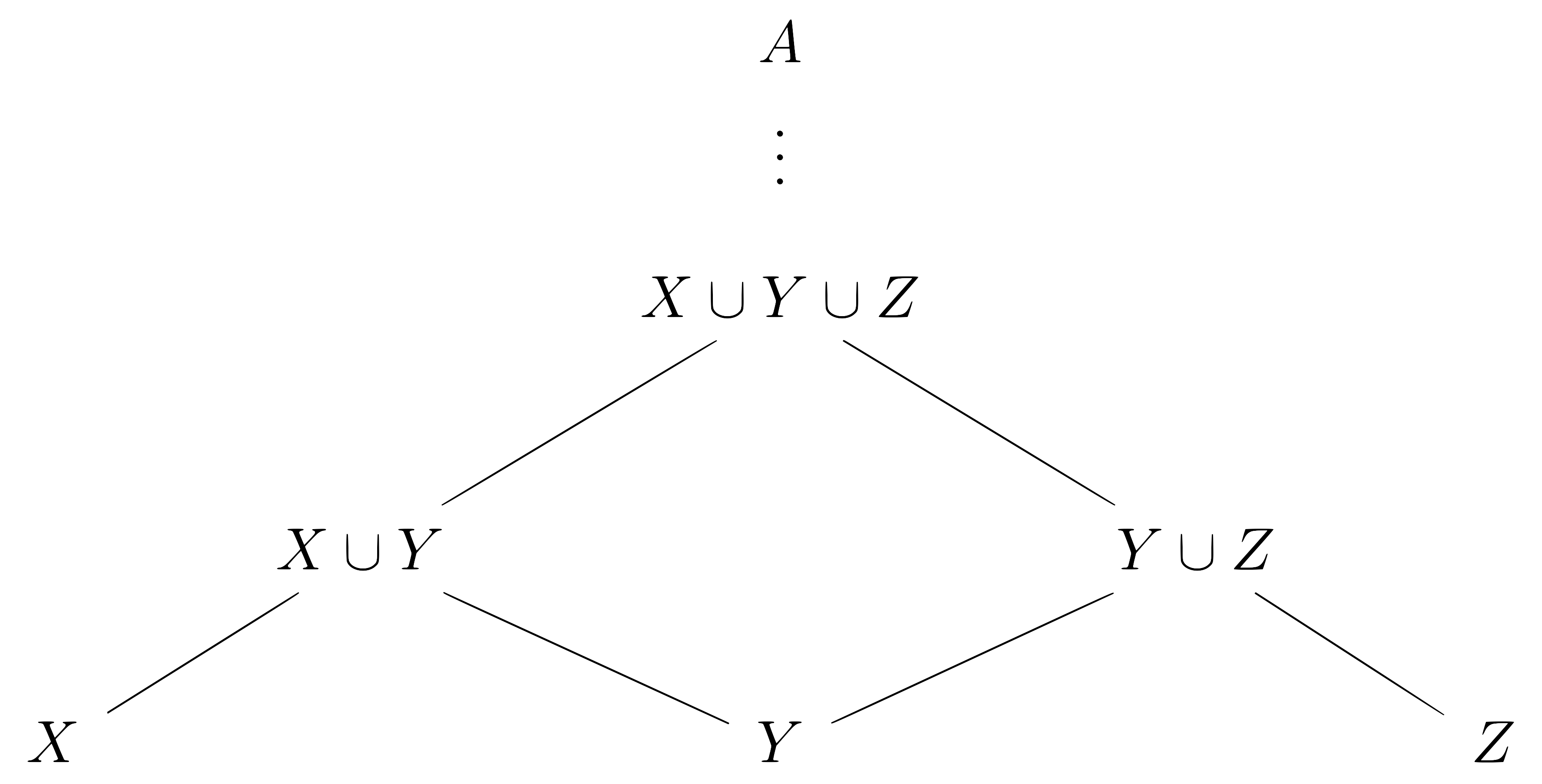
For example, for any set \(A\), the ordered set \((\mathcal{P}(A),\subseteq)\) is right directed: for any \(X, Y\in\mathcal{P}(A)\), the union \(X\cup Y\) belongs to \(\mathcal{P}(A)\) and is an upper bound of both \(X\) and \(Y\). This is illustrated by the following diagram.
Proposition 2 If an ordered set \(A\) is right directed, then every maximal element of \(A\) is also a greatest element.
Proof
Since \(A\) is right directed, for any \(x\in A\) and any maximal element \(a\), the set \(\{x,a\}\) has an upper bound \(y\). By maximality of \(a\) we must have \(a=y\), and therefore \(x\leq a\).
Proposition 3 If \((A_i)\) is a family of right directed sets, then \(\prod A_i\) is also right directed.
Proof
Let \((x_i),(y_i)\in\prod A_i\). For each \(i\), since \(x_i,y_i\in A_i\) and \(A_i\) is right directed, there exists \(z_i\in A_i\) with \(x_i,y_i\leq z_i\). Then \((x_i),(y_i)\leq(z_i)\), so \(\prod A_i\) is right directed.
In general, a subset of a right directed set need not be right directed. However, one easily verifies that every cofinal subset is right directed.
Definition 4 An ordered set \(A\) is a lattice if every two-element subset of \(A\) has a supremum and an infimum. In this case, \(\sup\{x,y\}\) and \(\inf\{x,y\}\) are called the join and meet of \(x\) and \(y\), respectively, and are written \(x\vee y\) and \(x\wedge y\).
Every finite subset of a lattice \(A\) has a supremum and an infimum. If every subset of \(A\) has a supremum and an infimum, then \(A\) is called a complete lattice.
Totally Ordered Set
Definition 5 Two elements \(x\) and \(y\) in a preordered set \(A\) are comparable if \(x\leq y\) or \(y\leq x\). If every two elements of \(A\) are comparable, then \(A\) is called a totally ordered set.
If \(A\) is a totally ordered set, then trichotomy holds: for any \(x, y\in A\), exactly one of
\[x=y,\qquad x < y,\qquad x > y\]holds. In this case the negation of \(x\leq y\) is \(x > y\); without the totally ordered hypothesis this is generally false. (§Definition of Order Relations, ⁋Remark 11)
Proposition 6 Every strictly monotone function \(f\) from a totally ordered set \(A\) to an ordered set \(B\) is injective. If \(f\) is strictly increasing, then \(f\) is an isomorphism from \(A\) onto \(f(A)\).
Proof
Let \(f\) be strictly monotone. For any \(x\neq y\), either \(x > y\) or \(x < y\), so \(f(x) > f(y)\) or \(f(x) < f(y)\); hence \(f(x)\neq f(y)\), and \(f\) is injective. In particular, if \(f\) is strictly increasing, we must show \(f(x)\leq f(y)\implies x\leq y\), whose contrapositive is obvious.
The preceding proposition also fails for general ordered sets. (§Monotone Functions, ⁋Remark 6)
Proposition 7 Let \(A\) be a totally ordered set and let \(X\subseteq A\). Then \(b\in A\) is the supremum of \(X\) if and only if \(b\) is an upper bound of \(X\) and, for every \(c\in A\) with \(c < b\), there exists \(x\in X\) such that \(c < x\leq b\).
Proof
Obvious.
Let \(A\) be an ordered set, and suppose \(a\leq b\). The subset \(X\subseteq A\) consisting of all \(x\) satisfying \(a\leq x\leq b\) is called a closed interval and is denoted \([a,b]\). The interval \((a,b)\) is called an open interval; it is the set of all \(x\) satisfying \(a < x < b\).
Likewise, the subset of all \(x\) satisfying \(x\leq a\) is called an unbounded closed interval and is denoted \((-\infty, a]\). The notations \([a,\infty)\), \((-\infty, a)\), and \((a, \infty)\) are defined analogously.
Proposition 8 In a lattice, the intersection of two intervals is again an interval.
References
[Bou] N. Bourbaki, Theory of Sets. Elements of mathematics. Springer Berlin-Heidelberg, 2013.
Share on
Twitter Facebook LinkedInComments
- Public repository: a deleted comment stays in the Git history.
- The password and the email are encrypted and kept in Cloudflare KV alone.
No comments yet.