미분다양체
Implicit Function Theorem
Implicit function theorem on smooth manifolds and its consequences
First, we define the following.
Definition 1 Let a manifold \(M\) and a coordinate system \((U,\varphi)\) be given. Let \(\varphi=(x^i)_{i=1}^m\), let \(0\leq k\leq m\), and for \(p\in \varphi(U)\), the manifold given by the set
\[S=\{q\in U\mid x^i(q)=r^i(p), k+1\leq i\leq m\}\]endowed with the subspace topology and the coordinate system \((S, (x^j\vert_S)_{j=1}^k)\) is called a slice of \((U,\varphi)\).
Lemma 2 Let an immersion \(F:M\rightarrow N\) between two manifolds be given. Then for each \(p\in M\), there exist a coordinate system \((V,\varphi)\) containing \(F(p)\) and an open neighborhood \(U\) of \(p\) such that \(F\vert_U\) is injective and \(F(U)\) is a slice of \((V,\varphi)\).
Proof
Let \(\dim M=k\) and \(\dim N=n\). Choose, containing \(F(p)\), a coordinate system \((V_0,\psi)\), \(\psi=(y^i)_{i=1}^n\). Since \(\dd{F_p}\) is injective, by §Submanifolds and the Inverse Function Theorem, ⁋Corollary 10 (Rank theorem, Immersion case), a suitable subset of the set \(\{y^i\circ F\}\) forms, near the point \(p\), a coordinate system for \(M\). Rearranging the order of coordinates, we may assume that \(x^j=y^j\circ F\) (\(j=1,\ldots,k\)) form, on a suitable open neighborhood of \(p\), denoted \(U_1\), a coordinate system \((U_1,x)\), \(x=(x^j)_{j=1}^k\). Shrinking \(U_1\) if necessary, we may assume \(F(U_1)\subseteq V_0\).
First, \(F\vert_{U_1}\) is injective. If \(q,q'\in U_1\) satisfy \(F(q)=F(q')\), then for each \(j\leq k\) we have \(x^j(q)=y^j(F(q))=y^j(F(q'))=x^j(q')\), because \(x\) is injective on \(U_1\).
Now on \(U_1\), let us express \(F\) in coordinates. For \(j\leq k\), since \(y^j\circ F=x^j\), the map \(\psi\circ F\circ x^{-1}:x(U_1) \rightarrow \mathbb{R}^n\) has the identity as its first \(k\) components; thus there exist \(C^\infty\) functions \(h^i:x(U_1) \rightarrow \mathbb{R}\) (\(i=k+1,\ldots,n\)) such that for every \(q\in U_1\),
\[\psi(F(q))=\bigl(x^1(q),\ldots,x^k(q),h^{k+1}(x(q)),\ldots,h^n(x(q))\bigr)\]holds. That is, \(F(U_1)\) is, in \(\psi\)-coordinates, the graph of the function \(h=(h^{k+1},\ldots,h^n)\).
Now consider the open subset of \(V_0\)
\[V'=\left\{q'\in V_0\mid (y^1(q'),\ldots,y^k(q'))\in x(U_1)\right\}\]then \(F(p)\in V'\). On \(V'\), define new functions by
\[w^j=y^j\quad (j=1,\ldots,k),\qquad w^i=y^i-h^i(y^1,\ldots,y^k)\quad (i=k+1,\ldots,n)\]Then at the point \(F(p)\),
\[\dd{w}^j=\dd{y}^j\quad(j\leq k),\qquad \dd{w}^i=\dd{y}^i-\sum_{j=1}^k\frac{\partial h^i}{\partial y^j}\dd{y}^j\quad(i>k)\]so the \(\dd{w}^i\) are obtained from the basis \(\dd{y}^i\) via a triangular matrix transformation whose diagonal entries are all \(1\), and thus are linearly independent. Therefore, by §Submanifolds and the Inverse Function Theorem, ⁋Corollary 6, on a suitable open neighborhood of \(F(p)\), \(V\subseteq V'\), \(\varphi=(w^1,\ldots,w^n)\) becomes a coordinate system.
Finally, let \(U=U_1\cap F^{-1}(V)\). For any \(q\in U\) and \(i>k\),
\[w^i(F(q))=y^i(F(q))-h^i(x(q))=h^i(x(q))-h^i(x(q))=0\]Conversely, suppose that \(q'\in V\) satisfies, for all \(i>k\), that \(w^i(q')=0\). Setting \(b=(y^1(q'),\ldots,y^k(q'))\), we have \(b\in x(U_1)\), and since the point \(F(x^{-1}(b))\) has \(\psi\)-coordinates \((b,h(b))\), which coincide with the coordinates of \(q'\) in \(\psi\), we have \(q'=F(x^{-1}(b))\). In particular, since \(q'\in V\), we have \(x^{-1}(b)\in U_1\cap F^{-1}(V)=U\), that is, \(q'\in F(U)\). In summary,
\[F(U)=\left\{q'\in V\mid \text{$w^i(q')=w^i(F(p))=0$ for $i=k+1,\ldots,n$}\right\}\]and therefore \(F(U)\) is a slice of \((V,\varphi)\).
In the lemma above, it is worth noting that for an open set of \(M\), say \(U\), \(F(U)\) becomes a slice of \((V,\varphi)\). For example, \(F(M)\cap V\) does not in general have to be a slice, and this remains true even when \(F\) is a submanifold.
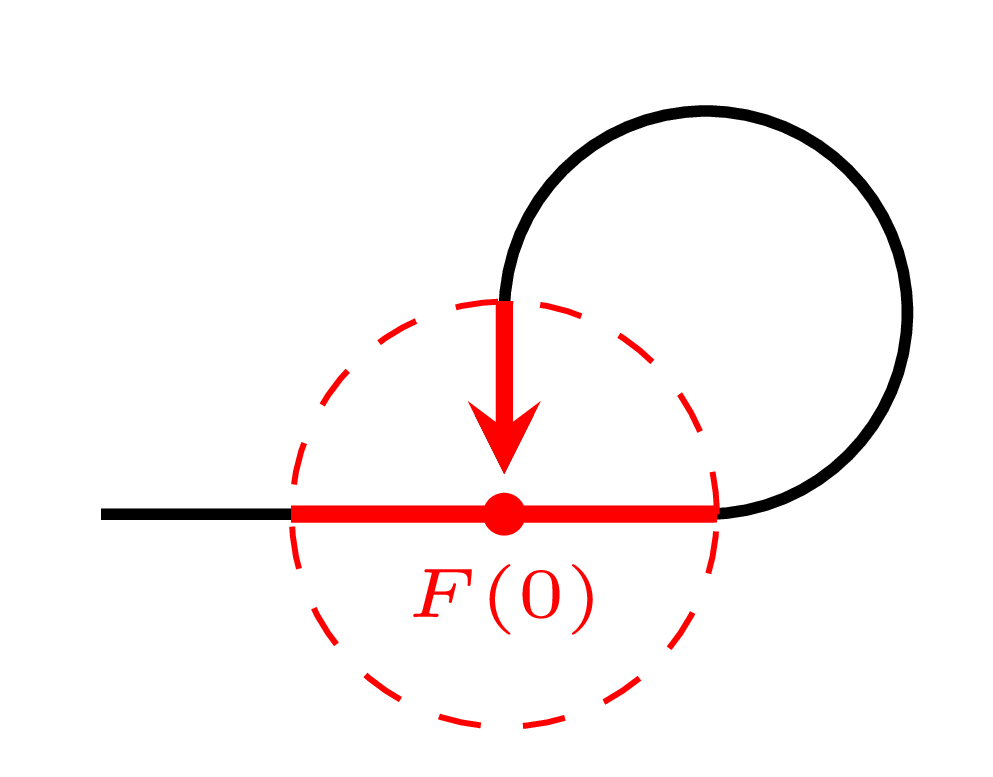
However, if \(F\) were an embedding, we could choose \((V,\varphi)\) appropriately so that \(F(M)\cap V\) is a slice of \(V\). From this perspective, we can summarize the above lemma roughly as
An immersed submanifold is locally embedded.
Implicit Function Theorem and Its Consequences
We are now ready to extend the implicit function theorem to differentiable manifolds.
Theorem 3 (Implicit function theorem) Let \(U\subseteq\mathbb{R}^{m-n}\times\mathbb{R}^n\) be an open subset, and for distinction, let the coordinates of \(\mathbb{R}^{m-n}\) be \(s^1,\ldots, s^{m-n}\), and the coordinates of \(\mathbb{R}^n\) be \(r^1,\ldots, r^n\). Also, let \(f:U\rightarrow\mathbb{R}^n\) be \(C^\infty\), and suppose that for some point \((s_0,r_0)\in U\), we have \(f(s_0,r_0)=0\). If at the point \((s_0,r_0)\), the Jacobian matrix
\[\begin{pmatrix}\partial f^1/\partial s^1&\partial f^1/\partial s^2&\cdots&\partial f^1/\partial s^{m-n}&\partial f^1/\partial r^1&\partial f^1/\partial r^2&\cdots&\partial f^1/\partial r^n\\\partial f^2/\partial s^1&\partial f^2/\partial s^2&\cdots&\partial f^2/\partial s^{m-n}&\partial f^2/\partial r^1&\partial f^2/\partial r^2&\cdots&\partial f^2/\partial r^n\\ \vdots&\vdots&\ddots&\vdots&\vdots&\vdots&\ddots&\vdots\\\partial f^n/\partial s^1&\partial f^n/\partial s^2&\cdots&\partial f^n/\partial s^{m-n}&\partial f^n/\partial r^1&\partial f^n/\partial r^2&\cdots&\partial f^n/\partial r^n\end{pmatrix}\]has the property that its \(n\times n\) submatrix
\[\begin{pmatrix}\partial f^1/\partial r^1&\partial f^1/\partial r^2&\cdots&\partial f^1/\partial r^n\\\partial f^2/\partial r^1&\partial f^2/\partial r^2&\cdots&\partial f^2/\partial r^n\\\vdots&\vdots&\ddots&\vdots\\\partial f^n/\partial r^1&\partial f^n/\partial r^2&\cdots&\partial f^n/\partial r^n\end{pmatrix}\]is nonsingular, then there exist an open neighborhood of \(s_0\), denoted \(V\), an open neighborhood of \(r_0\), denoted \(W\), and a \(C^\infty\) function \(g:V\rightarrow W\) such that \(V\times W\subseteq U\), and for each \((p,q)\in V\times W\),
\[f(p,q)=0\iff q=g(p)\]is satisfied.
Corollary 4 (Submersion level set theorem) Let \(F:M\rightarrow N\) be \(C^\infty\), fix \(q\in F(M)\), and let \(P=F^{-1}(q)\). If for every \(p\in P\), the differential \(\dd{F_p}:T_pM\rightarrow T_{F(p)}N\) is surjective, then there exists a unique manifold structure defined on \(P\) such that the canonical injection \(\iota:P\hookrightarrow M\) is a submanifold.
Moreover, in this case \(\iota\) is an embedding, and the codimension of \(P\), \(\dim M-\dim P\), is equal to \(\dim N\).”
Proof
Let \(\dim M=m\) and \(\dim N=n\). Fix an arbitrary \(p\in P\), and choose a coordinate system \((Y,\psi)\), \(\psi=(y^j)_{j=1}^n\) containing \(q=F(p)\) such that \(\psi(q)=0\). Since \(\dd{F_p}\) is surjective, by §Submanifolds and the Inverse Function Theorem, ⁋Corollary 9 (Rank theorem, Submersion case), there exist functions \(x^{n+1},\ldots,x^m\) such that
\[x^1=y^1\circ F,\quad\ldots,\quad x^n=y^n\circ F,\qquad x^{n+1},\quad\ldots,\quad x^m\]form, on a suitable open neighborhood of \(p\), denoted \(W\), a coordinate system. Shrinking \(W\) if necessary, we may assume \(F(W)\subseteq Y\). Then for \(w\in W\), having \(F(w)=q\) is equivalent, since \(\psi\) is injective, to \(y^j(F(w))=0\) holding for all \(j\leq n\), and therefore
\[P\cap W=\left\{w\in W\mid x^1(w)=\cdots=x^n(w)=0\right\}\]That is, rearranging the order of coordinates, \(P\cap W\) is a slice of the coordinate system \((W,(x^i)_{i=1}^m)\).
Now endow \(P\) with the subspace topology of \(M\), and to each slice obtained above, assign the function
\[\varphi_p=(x^{n+1},\ldots,x^m)\big\vert_{P\cap W}\]Since \(x=(x^i)_{i=1}^m\) is a homeomorphism from \(W\) to the open subset \(x(W)\subseteq\mathbb{R}^m\), \(\varphi_p\) is a homeomorphism from \(P\cap W\) to the open subset \(\{a\in\mathbb{R}^{m-n}\mid (0,a)\in x(W)\}\). Moreover, the transition between two charts \((P\cap W,\varphi_p)\) and \((P\cap W',\varphi_{p'})\) is given by
\[\varphi_{p'}\circ\varphi_p^{-1}:a\mapsto \bigl(\text{$x'\circ x^{-1}(0,a)$의 마지막 $m-n$개의 성분}\bigr)\]which, between two coordinate systems of \(M\), is the composition and restriction of \(C^\infty\) transition functions, and thus is \(C^\infty\). Since \(P\) is Hausdorff and second countable as a subspace of \(M\), these charts make \(P\) into an \((m-n)\)-dimensional manifold.
With respect to this structure, \(\iota:P\hookrightarrow M\) is of the form \(a\mapsto(0,a)\) in coordinates and thus is \(C^\infty\), and \(\dd{\iota}\) is injective at every point. That is, \(\iota\) is an injective immersion and therefore a submanifold, and since \(P\) was endowed with the subspace topology from the beginning, it is an embedding. Counting dimensions, the codimension of \(P\) is \(\dim M-\dim P=m-(m-n)=n=\dim N\).
Finally, the uniqueness of this manifold structure follows from §Uniqueness of Submanifolds, ⁋Proposition 5. This is because \((P,\iota)\) has a differential structure that makes it a submanifold of \(M\) with respect to the subspace topology, and this structure is the unique manifold structure making \((P,\iota)\) a submanifold of \(M\).
The following corollary does not require \(\dd{F_p}\) to be surjective, but only that its rank is constant, so it can be used even when the preceding corollary does not apply.
Corollary 5 (Constant-rank level set theorem) Let \(F:M\rightarrow N\) be \(C^\infty\), and suppose that \(\dd{F_p}:T_pM\rightarrow T_{F(p)}N\) has the same rank \(r\) at every point \(p\in M\). Fixing \(q\in F(M)\) and letting \(P=F^{-1}(q)\), there exists a unique manifold structure defined on \(P\) such that the canonical injection \(\iota:P\hookrightarrow M\) is a submanifold.
Moreover, in this case \(\iota\) is an embedding, and the codimension of \(P\), \(\dim M-\dim P\), is equal to \(r\).
Using these theorems, we can show that a particular subset of a given manifold \(M\) is an embedded submanifold, which typically follows an argument such as the following.
Example 6 Consider the function from \(\mathbb{R}^{n+1}\) to \(\mathbb{R}\) given by
\[f(x)=\lvert x\rvert^2=\sum_{i=1}^{n+1} r^i(x)^2\]For any point \(x\in \mathbb{R}^{n+1}\) and \(v\in T_x\mathbb{R}^{n+1}\),
\[\dd{f_x}(v)=v(f)=\sum v^i\frac{\partial f}{\partial r^i}\bigg\vert_{x}=2\sum r^i(x) v^i\]holds, from which we see that as long as \(x\) is not the origin, by adjusting \(v\) we can make \(\dd{f_x}(v)\) take any real value. That is, since \(\dd{f_x}\) is always surjective away from the origin, there exists a unique manifold structure such that \(f^{-1}(1)\) is a submanifold of \(\mathbb{R}^{n+1}\). By uniqueness, this structure coincides with the manifold structure given to \(S^n\), and by Corollary 4 (Submersion level set theorem) again, we see that this is an embedded submanifold of \(\mathbb{R}^{n+1}\).
References
[War] Frank W. Warner. Foundations of Differentiable Manifolds and Lie Groups, Graduate texts in mathematics, Springer, 2013
[Lee] John M. Lee. Introduction to Smooth Manifolds, Graduate texts in mathematics, Springer, 2012
Share on
Twitter Facebook LinkedInComments
- Public repository: a deleted comment stays in the Git history.
- The password and the email are encrypted and kept in Cloudflare KV alone.
No comments yet.