
미분다양체
Differentials
The differential between two tangent spaces
We previously defined the tangent space \(T_pM\) of a manifold \(M\), showed that its dimension equals that of \(M\) itself, and also defined its natural basis. In this post we define functions between two manifolds and examine how they act on tangent spaces.
Functions between Smooth Manifolds
Definition 1 Let two manifolds \(M,N\) be given. A function \(F:M\rightarrow N\) is said to be \(C^\infty\) at a point \(p\in M\) if there exist a coordinate system \((U,\varphi)\) containing \(p\) and a coordinate system \((V,\psi)\) with \(F(U)\subseteq V\) such that \(\psi\circ F\circ\varphi^{-1}\) is \(C^\infty\).
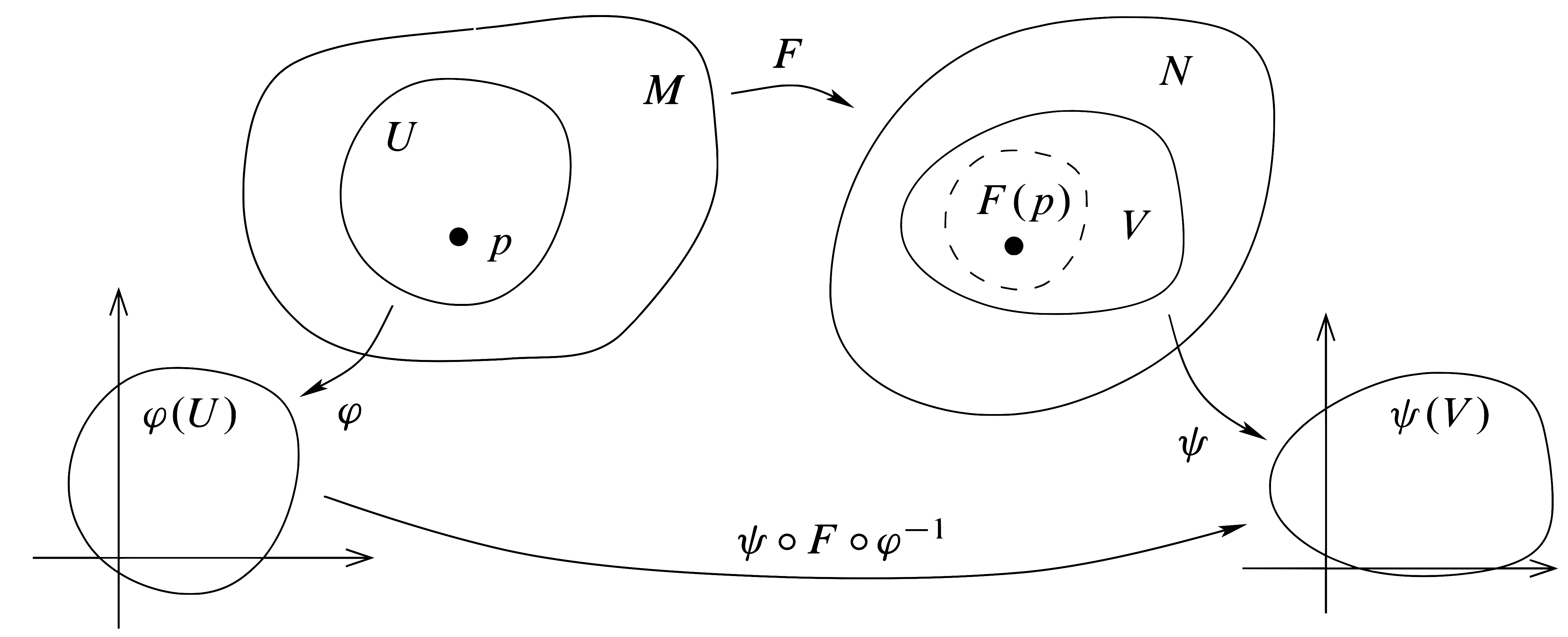
If \(F\) is \(C^\infty\) at every point, we simply call it a \(C^\infty\) function.
As when we previously defined \(C^\infty\) functions from a manifold to \(\mathbb{R}\), one should verify that this definition is independent of the choice of coordinate system; but this is essentially identical to what we proved after §Smooth Manifolds, ⁋Definition 2, so we omit it.
Proposition 2 Let two manifolds \(M,N\) be given. If \(F:M\rightarrow N\) is \(C^\infty\) at a point \(p\in M\), then \(F\) is continuous at \(p\).
Proof
Assume the situation of Definition 1. Then the function \(\psi\circ F\circ\varphi^{-1}:\varphi(U)\rightarrow\psi(V)\) between Euclidean spaces is \(C^\infty\). Since it is differentiable, it is certainly continuous. But \(\varphi\) and \(\psi\) are both homeomorphisms, so
\[F=\psi^{-1}\circ(\psi\circ F\circ\varphi^{-1})\circ\varphi\]is continuous as a composition of continuous functions.
Example 3 \(\id_M:M\rightarrow M\) is obviously a \(C^\infty\) function. More generally, if any open subset \(U\subseteq M\) is given the open submanifold structure (§Examples of Differentiable Manifolds, ⁋Definition 3), the inclusion map \(U\hookrightarrow M\) is a \(C^\infty\) function.
Example 4 For any two manifolds \(M,N\), the constant map sending every point \(p\in M\) to a fixed point \(q\in N\) is \(C^\infty\).
We have now defined the manifolds that constitute our objects of study, as well as the functions between them. The following proposition is readily verified.
Proposition 5 For three manifolds \(M,N,P\), if both \(F:M\rightarrow N\) and \(G:N\rightarrow P\) are \(C^\infty\), then their composition \(G\circ F\) is also \(C^\infty\).
It is then clear that isomorphisms between manifolds should be defined as follows.
Definition 6 If for two manifolds \(M,N\) there exist \(F:M\rightarrow N\) and \(G:N\rightarrow M\) such that \(G\circ F=\id_M\) and \(F\circ G=\id_N\), then we call each of \(F\) and \(G\) a diffeomorphism, and say that \(F\) and \(G\) are diffeomorphic.
Thus, manifolds and smooth functions form the category \(\Man\).
Remark One can endow the same topological manifold \(M\) with distinct smooth structures that are diffeomorphic to each other but not identical. Define two smooth structures \(\mathcal{A}_1\), \(\mathcal{A}_2\) by the single charts \((\mathbb{R},\id_\mathbb{R})\) and \((\mathbb{R}, x\mapsto x^{3})\), respectively. Then \(\mathcal{A}_1\) and \(\mathcal{A}_2\) define different smooth structures. (§Smooth Manifolds, ⁋Example 4)
For convenience, write \((M,\mathcal{A}_1)=M_1\), \((M,\mathcal{A}_2)=M_2\), \(\varphi=\id_\mathbb{R}\), and \(\psi=(x\mapsto x^3)\).
These two manifolds \(M_1, M_2\) are diffeomorphic to each other. Define the function \(F:M_1\rightarrow M_2\) by \(x\mapsto x^{1/3}\). Then obviously \(F^{-1}\) is given by \(y\mapsto y^3\). By definition \(F\) is \(C^\infty\). For any point \(p\in M_1\), taking the coordinate systems \((\mathbb{R},\varphi)\) on \(M_1\) and \((\mathbb{R},\psi)\) on \(M_2\), it is obvious that \(p\in\mathbb{R}\) and \(F(\mathbb{R})\subseteq\mathbb{R}\), and since they satisfy
\[(\psi\circ F\circ \varphi^{-1})(t)=t\]we have that \(\psi\circ F\circ\varphi^{-1}\) is \(C^\infty\).
Moreover, \(F^{-1}\) is also \(C^\infty\), because similarly for any point \(q\in M_2\), taking the same coordinate systems as above, we have \(q\in\mathbb{R}\) and \(F^{-1}(\mathbb{R})\subseteq\mathbb{R}\), and moreover
holds.
Differentials
A manifold is, fundamentally, a space in which differentiation is possible; hence to understand a function between manifolds we must know how it transforms derivations, that is, elements of the tangent space.
Let a \(C^\infty\) function \(F:M\rightarrow N\) between two manifolds be given. The function \(F\) naturally induces the function \(F^\ast:\mathcal{C}_{N,F(p)}^\infty\rightarrow \mathcal{C}_{M,p}^\infty\) defined by the formula
\[g\mapsto g\circ F\]Moreover, for any \(f,g\in \mathcal{C}_{N,F(p)}^\infty\) and any real number \(\alpha\in\mathbb{R}\),
\[F^\ast(f+g)=(f+g)\circ F=f\circ F+g\circ F=F^\ast(f)+F^\ast(g),\quad F^\ast(\alpha f)=(\alpha f)\circ F=\alpha(f\circ F)=\alpha F^\ast(f)\]hold, so \(F^\ast\) is a linear map between two \(\mathbb{R}\)-vector spaces.
On the other hand, \(T_pM\) and \(T_{F(p)}N\) consist of those elements among linear maps from \(\mathcal{C}^\infty_{M,p}\) and \(\mathcal{C}^\infty_{N,F(p)}\) to \(\mathbb{R}\) that satisfy the Leibniz rule; hence they are subspaces of the respective dual spaces \((\mathcal{C}^\infty_{M,p})^\ast\) and \((\mathcal{C}^\infty_{N,F(p)})^\ast\). Therefore, we can consider the dual map \((F^\ast)^\ast:(\mathcal{C}^\infty_{M,p})^\ast\rightarrow(\mathcal{C}^\infty_{N,F(p)})^\ast\) of the linear map \(F^\ast:\mathcal{C}^\infty_{N,F(p)}\rightarrow \mathcal{C}^\infty_{M,p}\) obtained above.
Explicitly, this is the function defined for any linear map \(L\in (\mathcal{C}^\infty_{M,p})^\ast\) by
\[(F^\ast)^\ast(L)=L\circ F^\ast\]Restricting this definition to \(T_pM\) yields the desired definition.
Before proceeding, let us recast the above discussion from the viewpoint of elements of the vector spaces: \((F^\ast)^\ast\vert_{T_pM}\) sends any \(v\in T_pM\) to \(v\circ F^\ast\in (\mathcal{C}^\infty_{N,F(p)})^\ast\). On the other hand, since \(v\circ F^\ast\) is an element of \((\mathcal{C}^\infty_{N,F(p)})^\ast\), it is determined by its action on any \(g\in \mathcal{C}^\infty_{N,F(p)}\), namely
\[(v\circ F^\ast)(g)=v(F^\ast(g))=v(g\circ F)\]Moreover, this \(v\circ F^\ast\) actually belongs to \(T_{F(p)}N\). That is, it satisfies the Leibniz rule. This follows from the formula
\[\begin{aligned}(v\circ F^\ast)(fg)&=v(F^\ast(fg))=v((f\circ F)(g\circ F))\\ &=(f\circ F)(p)v(g\circ F)+(g\circ F)(p) v(f\circ F)\\ &=f(F(p))(v\circ F^\ast)(g)+g(F(p))(v\circ F^\ast)(f)\end{aligned}\]Summarizing the discussion so far, we obtain the following.
Definition 7 Let \(F:M\rightarrow N\) be a \(C^\infty\) function between two manifolds. For any \(p\in M\), the differential of \(F\) at the point \(p\), \(\dd{F_p}:T_pM\rightarrow T_{F(p)}N\), is the linear map defined for any \(v\in T_pM\) and any \(g\in \mathcal{C}^\infty_{N,F(p)}\) by
\[(\dd{F_p}(v))g=v(g\circ F)\]Several consequences are immediate from the definition. First, for \(\id_M:M\rightarrow M\), the differential \(\dd{(\id_M)_p}\) is always the identity map \(\id_{T_pM}\) on \(T_pM\). This is clear from the formula in Definition 7. Also, for three manifolds \(M,N,P\), if \(F:M\rightarrow N\) and \(G:N\rightarrow P\) are \(C^\infty\), then the formula
\[\dd{(G\circ F)_p}=(\dd{G_{F(p)}})\circ (\dd{F_p})\]holds. This is obvious either from the fact that the pullback used to define the differential preserves composition, or by directly substituting \(G\circ F\) into the formula of Definition 7. From this one can show, among other things, that for a diffeomorphism \(F\), the differential \(\dd{F_p}\) is always an isomorphism of vector spaces.
However, there are many \(C^\infty\) functions whose differential is an isomorphism but which are not diffeomorphisms.
Proposition 8 For a manifold \(M\) and an open submanifold \(U\) of \(M\), the inclusion map \(\iota:U\hookrightarrow M\) induces an isomorphism between tangent spaces for every \(p\in U\). That is, \(\dd{\iota_p}\) is always an isomorphism.
Proof
This is obvious because \(\iota^\ast\) induces an isomorphism between \(\mathcal{C}^\infty_{U,p}\) and \(\mathcal{C}^\infty_{M,\iota(p)}\). In fact, from the outset there is no harm in regarding the two vector spaces as identical.
Bases of Tangent Spaces and Differentials
Regarding \(\mathbb{R}^m\) as an \(m\)-dimensional manifold, we can see that our definition of tangent vectors coincides exactly with directional vectors in \(\mathbb{R}^m\). In this case, for any \(p\in\mathbb{R}^m\), the standard \(m\) vectors of \(\mathbb{R}^m\) based at \(p\) define directional derivatives in their respective directions, and we agreed to write these as
\[\frac{\partial}{\partial r^1}\bigg\vert_p,\cdots,\frac{\partial}{\partial r^m}\bigg\vert_p\]For a general manifold, we chose a coordinate system \((U,\varphi)\) containing \(p\in M\), and expressed tangent vectors using the component functions \(x^1,\ldots, x^m\) of \(\varphi\) as
\[\frac{\partial}{\partial x^1}\bigg\vert_p,\cdots,\frac{\partial}{\partial x^m}\bigg\vert_p\]Then, for any \(f\in C^\infty_p(M)\),
\[\frac{\partial}{\partial x^i}\bigg\vert_pf=\frac{\partial}{\partial r^i}\bigg\vert_p (f\circ\varphi^{-1})\]holds. However, keeping Definition 7 in mind and examining this formula again, we see that it has exactly the same form as the differential of \(\varphi^{-1}:\varphi(U)\rightarrow U\).1 In other words, the basis of the tangent space is nothing other than the \(m\) bases of the tangent space \(T_{\varphi(p)}\mathbb{R}^m\) of \(\mathbb{R}^m\) carried over via the differential \(\dd{\varphi}^{-1}_{\varphi(p)}\).
From a more linear-algebraic point of view, if \(\mathcal{B}\) is the standard basis of \(\mathbb{R}^m\) and \(\mathcal{C}\) is the basis of \(T_pM\) consisting of the \(\partial/\partial x^i\), then the matrix representation of the linear map \(\dd{\varphi}^{-1}_{\varphi(p)}\) from \((T_{\varphi(p)}\mathbb{R}^m, \mathcal{B})\) to \((T_pM, \mathcal{C})\) is precisely the identity matrix.
More generally, let \(M,N\) be manifolds of dimensions \(m,n\) respectively, and let \(F:M\rightarrow N\) be any \(C^\infty\) function. Then for a fixed \(p\in M\), there exist a coordinate system \((U,\varphi)\) containing \(p\) and a coordinate system \((V,\psi)\) containing \(F(U)\) such that \(\psi\circ F\circ\varphi^{-1}\) is \(C^\infty\). Now let \(\varphi=(x^i)_{i=1}^{m}\) and \(\psi=(y^j)_{j=1}^n\). Then the bases of the tangent spaces \(T_pM\) and \(T_{F(p)}N\) are given respectively by
\[\frac{\partial}{\partial x^1}\bigg\vert_p,\cdots,\frac{\partial}{\partial x^m}\bigg\vert_p,\quad\text{and}\quad\frac{\partial}{\partial y^1}\bigg\vert_{F(p)},\cdots\frac{\partial}{\partial y^n}\bigg\vert_{F(p)}\]Let us now represent \(\dd{F_p}\) as a matrix with respect to these. To do so, we express the image of each \(\partial/\partial x^i\) under \(\dd{F_p}\) as a linear combination of the \(\partial/\partial y^j\). That is, we need only find the coefficients \(a_{ji}\) in
\[\dd{F_p}\left(\frac{\partial}{\partial x^i}\bigg\vert_p\right)=a_{1i}\frac{\partial}{\partial y^1}\bigg\vert_{F(p)}+\cdots+a_{ni}\frac{\partial}{\partial y^n}\bigg\vert_{F(p)}\]But since the \(\partial/\partial y^j\) form the dual basis to the elements \(y^j+\mathfrak{n}^2\) of \(\mathfrak{n}/\mathfrak{n}^2\), it suffices to apply both sides to the function \(y^j\).2 Namely, from
\[\dd{F_p}\left(\frac{\partial}{\partial x^i}\bigg\vert_p\right)y^j=a_{1i}\frac{\partial}{\partial y^1}\bigg\vert_{F(p)}y^j+\cdots+a_{ji}\frac{\partial}{\partial y^j}\bigg\vert_{F(p)}y^j+\cdots+a_{ni}\frac{\partial}{\partial y^n}\bigg\vert_{F(p)}y^j\]by the definition of the dual basis the right-hand side reduces to \(a_{ji}\) alone, so
\[\dd{F_p}\left(\frac{\partial}{\partial x^i}\bigg\vert_p\right)y^j=a_{ji}\]and from this we see that the matrix representation of \(\dd{F_p}\) with respect to the bases \(\partial/\partial x^i\) and \(\partial/\partial y^j\) is the matrix
\[\begin{pmatrix}\partial(y^1\circ F)/\partial x^1&\partial(y^1\circ F)/\partial x^2&\cdots&\partial(y^1\circ F)/\partial x^m\\\partial(y^2\circ F)/\partial x^1&\partial(y^2\circ F)/\partial x^2&\cdots&\partial(y^2\circ F)/\partial x^m\\\vdots&\vdots&\ddots&\vdots\\\partial(y^n\circ F)/\partial x^1&\partial(y^n\circ F)/\partial x^2&\cdots&\partial(y^n\circ F)/\partial x^m\end{pmatrix}\]That is, this is nothing but the Jacobian of the function \(\psi\circ F\circ\varphi^{-1}\) between Euclidean spaces.
In particular, if \(M=N\) and \(F=\id_M\) but we choose different coordinate systems \((U, \varphi)\) and \((V,\psi)\), this becomes the Jacobian matrix of the transition map \(\psi\circ\varphi^{-1}\).
References
[War] Frank W. Warner. Foundations of Differentiable Manifolds and Lie Groups, Graduate texts in mathematics, Springer, 2013
[Lee] John M. Lee. Introduction to Smooth Manifolds, Graduate texts in mathematics, Springer, 2012
Share on
Twitter Facebook LinkedInComments
- Public repository: a deleted comment stays in the Git history.
- The password and the email are encrypted and kept in Cloudflare KV alone.
No comments yet.